
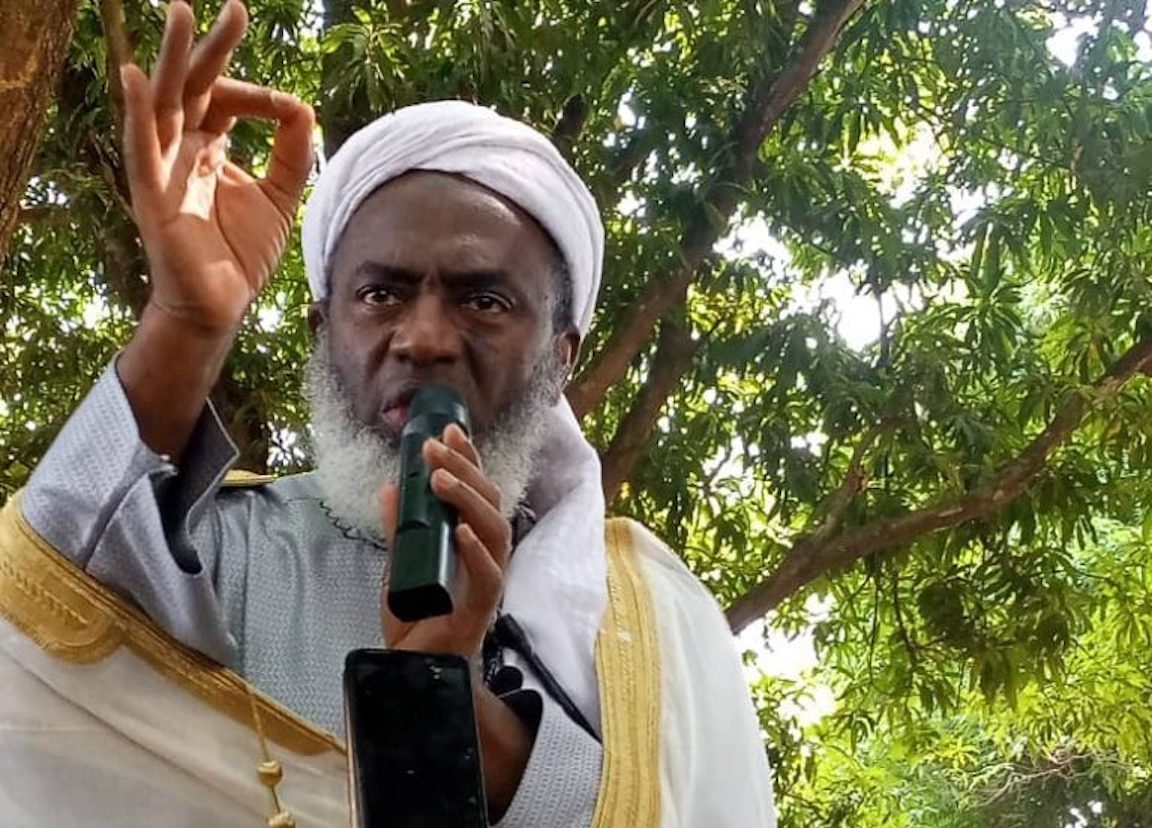
Sheikh Ahmad Gumi on Saturday reignited the long running national debate over whether Nigeria should open direct channels of communication with Boko Haram insurgents and bandits.
He argued that the same strategy once deployed to contain militancy in the Niger Delta should not be dismissed for the North.

The Islamic scholar said leaders who previously reached out to militants in the oil-rich region demonstrated that dialogue could complement security operations.
He questioned why similar engagements have become unacceptable when it comes to insurgents and bandits.
Posting his thoughts on Facebook, Gumi cited former President Goodluck Jonathan and former Vice-President Yemi Osinbajo as examples of senior government officials who personally met armed actors in the Niger Delta before broader peace initiatives were introduced.
“The former President Jonathan visited delta militants in the creeks, as did the former Vice-President Osinbajo. They all came up with a program to tame the militants,” he wrote.
He followed the reference with a pointed question that immediately shifted attention to the country’s prolonged insecurity in the North.
“Who is going to visit BH and Bandits to tame them without fools castigating them?” he asked.
The remarks are the latest in Gumi’s sustained advocacy for negotiations with armed groups.
The position has repeatedly placed him at the centre of public controversy.
Unlike many security commentators who insist that military action should remain the principal response to terrorism and banditry, the Kaduna based cleric has consistently maintained that dialogue can help break cycles of violence, encourage defections and create opportunities for lasting peace.
His position has never escaped criticism.
Many Nigerians argue that opening talks with groups accused of mass killings, kidnappings and other violent crimes risks legitimising criminal organisations and diminishing justice for victims and affected communities.
Others, however, point to instances where Gumi’s interventions reportedly facilitated the release of kidnapped victims.
They say negotiation should remain one of several options available to the government in resolving complex security crises.
Responding to allegations made against him over the years, the retired military officer has consistently denied supporting terrorism or banditry.
He has insisted that his engagements are motivated solely by efforts to stop bloodshed and persuade fighters to abandon violence.
The debate revived by Gumi draws from Nigeria’s experience in the Niger Delta, where years of attacks on oil facilities and violent agitation gradually gave way to a government backed amnesty and reintegration programme.
The Presidential Amnesty Programme, introduced in 2009 under the administration of the late President Umaru Musa Yar’Adua and sustained by Jonathan’s government, encouraged thousands of militants to surrender their weapons in exchange for rehabilitation, vocational training, education and reintegration.
The development led to a significant decline in attacks on critical oil infrastructure.
Jonathan had previously recounted entering the creeks in 2007 as vice president to meet former militant leader Government Ekpemupolo, popularly known as Tompolo, describing the encounter as one of the early steps that eventually shaped the amnesty initiative.
Years later, Osinbajo also undertook a series of visits to Niger Delta communities as acting president, holding consultations with community leaders and stakeholders while arguing that sustainable peace required addressing underlying grievances alongside security concerns.
Daily Trust reports that Gumi’s comments come at a time the Federal Government has continued to emphasise sustained military operations against insurgents and armed groups.
The government insisted that security forces remain under instruction to degrade terrorist networks across the North East and North West.
The intervention also comes amid renewed attacks by Boko Haram and ISWAP in parts of the North East, as well as persistent kidnappings and bandit assaults across several North Western and North Central states despite ongoing military offensives.
During the height of bandit violence in Zamfara and neighbouring states, Gumi made several visits to forests to meet armed groups, saying the engagements were aimed at persuading fighters to lay down their arms and facilitating the release of abductees.
Boko Haram has been designated a terrorist organisation by the Nigerian government, making any proposal for engagement with the group a subject of recurring legal, political and ethical debate.
Security analysts have often cautioned against drawing direct comparisons between the Niger Delta militancy and the Boko Haram insurgency, arguing that while the former was largely rooted in resource control agitation, the latter is driven by extremist ideology and has expanded into a transnational terrorist movement.
Some security analysts have also argued that dialogue has worked in some conflicts, but it can only succeed where there is a credible command structure, willingness to negotiate and strong enforcement mechanisms.
Gumi’s latest intervention is expected to rekindle the longstanding argument over whether Nigeria can defeat insurgency through military force alone or whether a carefully structured political dialogue should form part of a broader national security strategy.
Cc:DailyTrust