
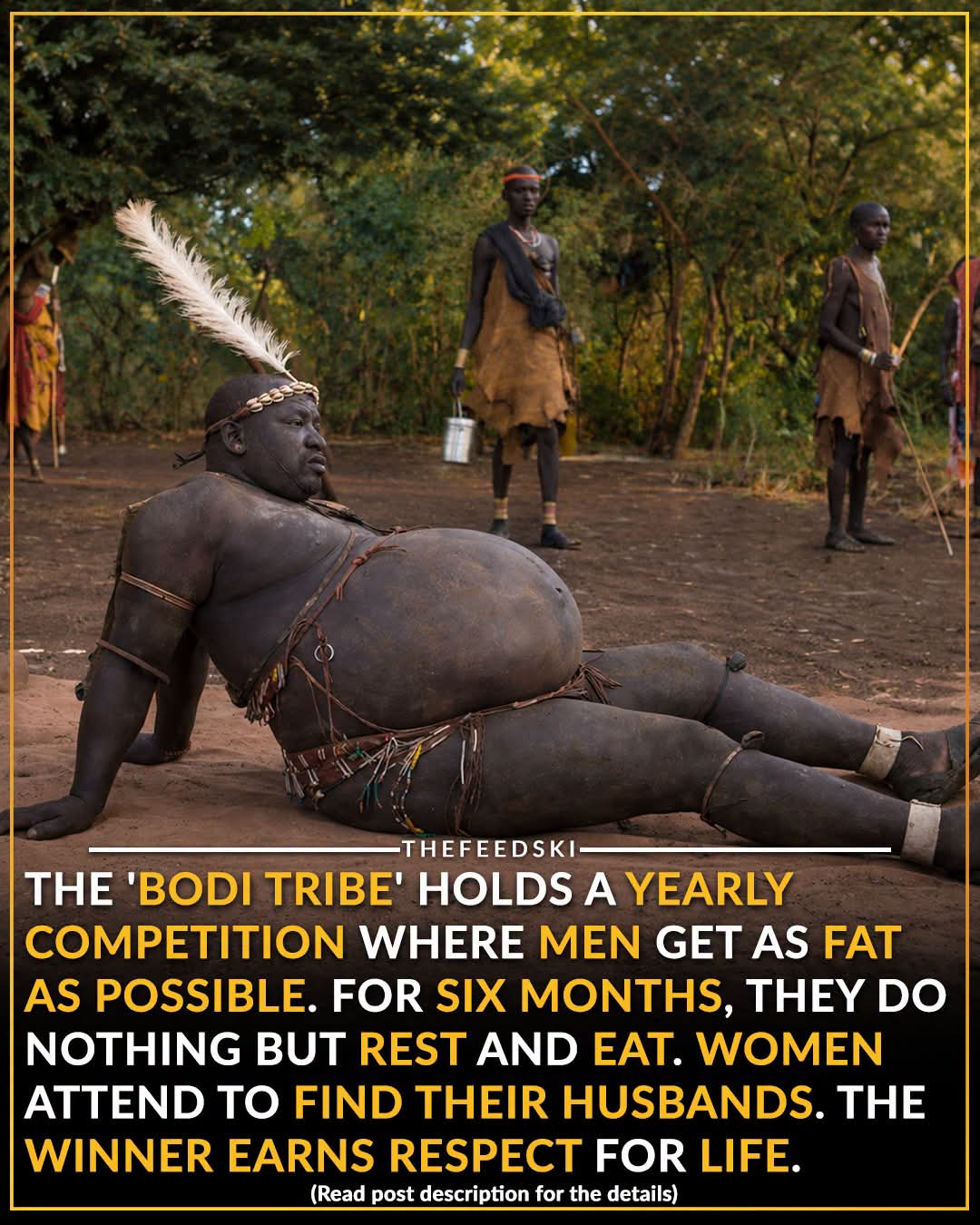
In Ethiopia’s Omo Valley, in one of the most remote corners of the country, the Bodi tribe has a tradition unlike anything else on earth. Every year, as part of their Ka’el festival marking the tribal new year, they hold a competition to find the fattest man in the community.
The preparation is serious.

Six months before the festival, one unmarried man from each of the tribe’s 14 clans is selected to compete. From that moment, their only job is to get as large as possible. They stop all physical activity entirely, spending their days resting in their huts while the women of the tribe bring them food. Their diet consists almost entirely of cow’s blood and fresh milk, consumed in enormous quantities throughout the day. The cows are too sacred to slaughter, so the men puncture a vein with a spear, collect a pot of blood, and seal the wound with clay.
By the time Ka’el arrives, the men have undergone dramatic physical transformations. They emerge painted in ash and clay, adorned with traditional decorations, their bodies barely resembling the men who went into isolation six months earlier.
On the day of the ceremony, the competitors walk for hours around a sacred tree while judges and tribespeople watch. The women of the tribe are there too, not just to support the men but to inspect the competition with their own interests in mind. In Bodi culture, a large body is considered the ultimate sign of attractiveness, and the Ka’el ceremony is one of the primary occasions women use to identify potential husbands.
The winner is declared the fat man of the year. He receives no prize money, no land, no material reward of any kind. What he receives is something the Bodi consider more valuable: the respect and adulation of the entire tribe, for the rest of his life.