
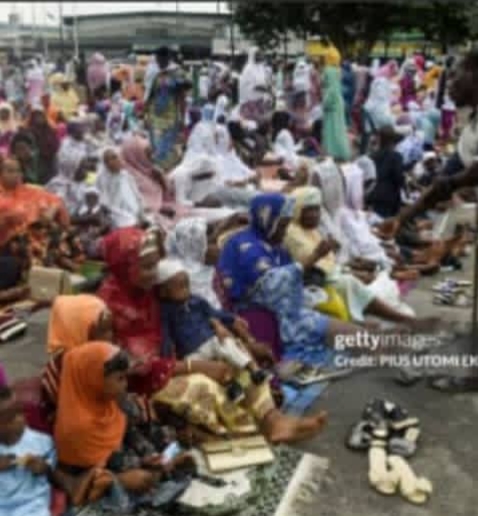
Beggars at Ayetoro Junction, Osogbo, no doubt constitute a prominent community where hundreds of people, mostly of non-Yoruba extraction, depend on begging as a means of livelihood and have made the location their regular place of operation.
Empirically speaking, one may be curious and inquisitive to ask questions about the extent to which these vulnerable people contribute to the development and growth of society, particularly in Osogbo and its adjoining towns.

People of different ages and social classes, including clerics are among those who patronise the beggars at Ayetoro Junction. The patronage appears to increase during the evening, especially on Fridays when high-profile individuals often visit the junction to distribute food items, clothing and money to the beggars.
Whether these visits are motivated by kindness, generosity or other considerations is a question best answered by the visitors themselves.
No doubt, many of those who patronise the Ayetoro beggars may do so out of genuine kindness and generosity. However, the long and short of the matter is that people of considerable social standing are among the regular visitors to the Ayetoro Junction beggars.
On the other hand, the patronage may also be linked to spiritual beliefs. Some prophets, clerics or herbalists may have advised individuals facing one challenge or another to engage in acts of giving to beggars. Life is enormously complex, and what may be considered acceptable or beneficial to one person may be viewed differently by another.
It is also important to note that, beyond individuals acting on the instructions of prophets or clerics, several non-governmental organisations (NGOs) and well-to-do individuals regularly visit the popular Ayetoro Junction in Osogbo to distribute food items and other materials to the beggars. This may be part of their organisations’ social responsibility initiatives or simply an act of giving back to society.
Meanwhile, even those who visit the Ayetoro beggars as part of what they consider atonement or sacrifice appear, based on observations, not to have had any evidently negative impact on the lives of the beggars. In fact, the enclave seems to be expanding day by day.
Beyond receiving money from passers-by, findings also suggest that drivers of minibuses, popularly known as korope, sometimes approach the beggars to exchange money with them. This raises an important question: if circumstances were to compel the beggars to go on strike, what would become of those who patronise them?
The beggars at Ayetoro Junction, Osogbo, should not necessarily be viewed as a liability but as people whose needs and circumstances deserve attention within the community. Similar groups can also be found in places such as Ikirun, Ede, Ilesa and Ile-Ife, among others, meaning that the phenomenon is not limited to Osogbo.
However, it may surprise and shock many residents of Osogbo to learn that findings allegedly indicate that the assembly of beggars pays charges for the spaces they occupy. This development could perhaps be linked to the popular adage that says, “Even in a free town, things are not free.”
It is important to note that, according to a source who pleaded anonymity, the alleged space charges are reportedly not remitted into the coffers of any government, whether at the state or local government level.
Who, then, collects the alleged space charges from the Ayetoro beggars? This remains a mystery and only time will tell.
Why are the Ayetoro Junction beggars considered essential to several notable and even less notable people in Osogbo and its environs? What attracts people to the location and who benefits from the activities taking place there?
Perhaps, rather than relying solely on assumptions, one may need to take the time to observe the situation at Ayetoro Junction personally.