
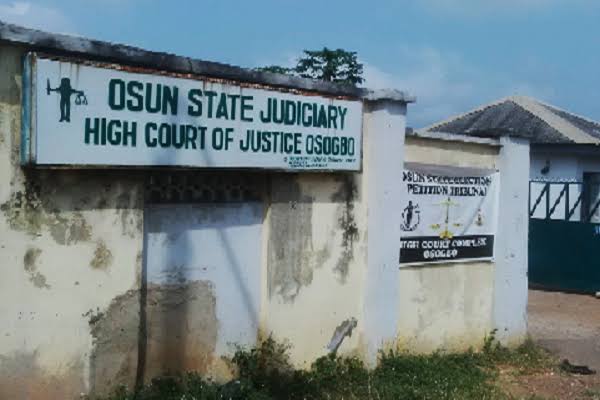
Ruling houses in Ijabeland, Osun State, have approached the Osun State High Court to challenge the state government’s decision to set aside the 2018 Amended Onijabe Chieftaincy Declaration, which regulates the selection and appointment of the Onijabe of Ijabe.
The ruling houses are seeking judicial intervention over the decision reportedly taken by the Osun State Executive Council on October 23, 2026, in a dispute that centres on the validity of the existing chieftaincy declaration and the process for filling the Onijabe stool.
The application was filed in Suit No. HKK/2/2018 before the High Court of Justice of Osun State, Okuku Judicial Division, by Tunde Ayodele Alabi, Samson Oladipupo, Ganiyu Opatola and Sulaimon Awoyeye, representing their respective families.
The families identified in the court documents are the Olukoyo Dodo, Obadoke, Alaase and Oloyede families of Ijabe. They maintain that their interests in the Onijabe chieftaincy are recognised under the 2018 Amended Onijabe Chieftaincy Declaration.
In their Motion on Notice, the applicants asked the court to set aside the proceedings, deliberations, conclusions and decisions of the Osun State Executive Council dated October 23, 2026, insofar as they concern the declaration and any recommendation, selection or approval of a person to occupy the Onijabe stool while the suit remains pending.
They also sought an order directing all parties to maintain the status quo ante bellum by refraining from approving, recognising or further recognising anyone as Onijabe of Ijabe pending the final determination of the case.
Another relief sought is an order restraining the relevant government authorities, particularly the Odo-Otin Local Government, the Odo-Otin Local Government Chieftaincy Committee, the Governor of Osun State and the Attorney-General of the state, from taking further steps concerning the vacant stool until the court resolves the dispute.
In an affidavit supporting the application, Alabi stated that he had the consent of the head and members of the Olukoyo Dodo family, as well as the other applicants, to depose to the facts presented before the court.
He maintained that the four families represented by the applicants were royal families entitled to ascend the Onijabe throne within their respective ruling houses in accordance with the 2018 Amended Onijabe Chieftaincy Declaration.
The affidavit traced the dispute to an earlier case, Suit No. HIK/43/97, which the applicants said was finally determined by the court on April 25, 2017, after proceedings spanning about 20 years.
According to the applicants, the earlier case involved efforts to stop the recommendation of the Okanlawon Panel, which they said subsequently formed the basis of the 2018 Amended Onijabe Chieftaincy Declaration.
The court documents state that, following the earlier judgment, the Osun State Government approved and registered the amended declaration on July 13, 2018, pursuant to Section 4(11) of the Chiefs Law, Cap. 25, Laws of Osun State, 2002.
The declaration was subsequently published in the Osun State Government Official Gazette on July 26, 2018. The applicants contend that it remains the applicable legal instrument regulating the selection and appointment of the Onijabe of Ijabe.
They further stated that the claimants in the earlier suit instituted the present proceedings after the declaration was issued, challenging the instrument that governs the selection and appointment of the traditional ruler.
The affidavit also disclosed that the claimants had filed an application for an injunction in the current suit, seeking to restrain the relevant parties from taking steps concerning the Onijabe stool, particularly in relation to the 2018 declaration. The applicants stated that the injunction application was yet to be heard or determined.
However, the applicants alleged that the parties opposing their position acted in concert and influenced the state executive council to set aside the declaration while the case was still pending.
These assertions form part of their allegations before the court and have not been established as judicial findings.
They further argued that the executive council’s action amounted to taking over the role of the court in a matter already before it.
According to the applicants, the decision of October 23, 2026, directly concerned the subject matter of the ongoing litigation.
A press release attached to the court documents as Exhibit A stated that the Osun State Executive Council had set aside the 2018 Amended Onijabe Chieftaincy Declaration and approved the appointment of Babatunde Omotosho Tajudeen as the Onijabe of Ijabeland, with immediate effect.
The applicants also stated that the government’s announcement was widely reported across electronic, print and social media platforms. They urged the court to reverse the steps taken by the government and restore the position that existed before the disputed decision.
In their written address, counsel to the applicants relied on Sections 6(6)(a) and 36(1) of the 1999 Constitution of Nigeria, as amended, alongside provisions of the Osun State High Court (Civil Procedure) Rules 2008 and the court’s inherent jurisdiction.
The applicants also cited judicial authorities, including *Governor of Lagos State v. Ojukwu* (1986), *Atake v. Attorney-General of the Federation* (1982), *Candide-Johnson v. Edigin* (1990), *Ogundiani v. Araba* (1978), *Barclays Bank v. Ashiru* (1978) and *Kotoye v. Central Bank of Nigeria* (1989), in support of their arguments on the authority of the court and the need to preserve the subject matter of pending litigation.
The motion, dated October 26, 2026, was filed by Maruf Adediran, R.T. Abdulateef and O.A. Folarin of Wulaemah Chambers, Osogbo. The applicants urged the court to grant the reliefs sought in the interest of justice and to protect the integrity of the judicial process.
The court’s determination of the application and the substantive chieftaincy dispute will establish the legal position on the issues raised.